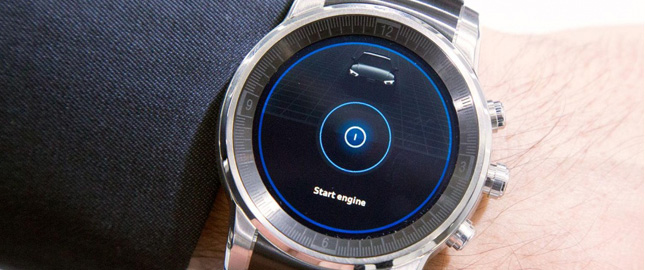
The 2015 Consumer Electronics Show in Las Vegas, or CES 2015 as it is more widely known, was the venue chosen for the introduction of the Audi LG smartwatch and it appears to have caused quite a buzz!
There have been many rumours around about the possibility of the release of a new LG smartwatch and this prototype is not only good looking but also truly “smart”. Instead of Android Wear the Audi/LG smartwatch runs on Open webOS, it has a Qualcomm Snapdragon 400 processor, is water resistant and is constructed of stainless steel with Sapphire crystal and a quality leather strap.
A smartwatch can be set up to alert you to incoming calls, text messages and emails, some will even enable you to check for Facebook and Twitter notifications. Most smartwatches will allow you to monitor your health, such as your heart rate and body temperature, they can also assist you with your fitness regime by tracking the amount of steps taken, distance covered, calories burned, etc. There are already many, many Apps available out there for the smartwatch user, such as weather updates, calendar, music, calculator, games and so on, as the smartwatch becomes more mainstream the amount and range of Apps available is certain to soar.
Audi and LG have not released a great deal of information about their smartwatch, reports of its features are varied and include cellular connectivity, smartphone camera control, health and fitness tracking, etc. However, the feature that has caused the buzz and got everyone excited is the one that enables you to pair with your car, using NFC. Near field communication (NFC) allows you to use the smartwatch as your set of car keys, all you need to do to unlock or lock your car is to simply tap the door handle, having gained access you can inform your car that you are inside by tapping an NFC enabled panel and then switch on the engine by tapping the “start engine” button. No keys required! It has been reported that this smartwatch can also control the stereo and adjust the settings for the vehicle’s climate control.
Head of Research and Development at Audi, Dr Ulrich Hackenberg, demonstrated the prototype of this incredible smartwatch at CES 2015 by using it to start an Audi Prologue and driving it onto the stage, Dr Hackenberg said “If I want to stop the engine, I can do that again with my smart watch”.
No price or launch date have been released for the Audi LG smartwatch, even its name remains a mystery, although it is widely expected to be available in the early part of 2016.
Special Thanks Nick Jaynes for providing the image
]]>
The government announced yesterday that January 2015 will see the arrival of driverless cars on public roads of the UK. Driverless cars have been in use in the UK for some time now, in experimental form by various groups of engineers and researchers but they have only been allowed on private roads so far.
The Business Secretary, Vince Cable, was visiting a Mira research facility in the Midlands when he spoke about the plans, “Today’s announcement will see driverless cars take to our streets in less than six months, putting us at the forefront of this transformational technology and opening up new opportunities for our economy and society,” he declared. The government has invited those cities around the country who are interested in hosting trials to compete against each other, three cities will host trials over a period of between 18 and 36 months and a £10 million fund will be shared among the winners towards their costs, any city interested will have to declare their interest by the beginning of October 2014.
Government ministers have also ordered a review of road regulations and traffic laws for the UK, including changes to the Highway Code to allow for new rules and guidelines regarding the addition of driverless cars on our roads, these new regulations should be published by the end of 2014. The Transport Minister, Claire Perry said “Driverless cars have huge potential to transform the UK’s transport network – they could improve safety, reduce congestion and lower emissions, particularly CO2. We are determined to ensure driverless cars can fulfil this potential which is why we are actively reviewing regulatory obstacles to create the right framework for trialling these vehicles on British roads.”
The UK is by no means the first to allow driverless cars on public roads, Google has been operating its driverless cars on Californian roads for some time now, with more than 300,000 miles covered – although this was mainly on the motorways, Florida and Nevada have also approved tests in the US. Japan began testing driverless cars on public highways in 2013 and Gothenburg in Sweden granted permission to Volvo for testing 100 driverless cars in 2017. Chinese search engine Baidu has also stated that it has begun developing a project for driverless cars.
There have been concerns raised around the world about the safety of driverless cars on public highways, with the legal practicalities and issues regarding insurance also causing unease. The FBI have gone even further, saying that driverless cars “will have a high impact on transforming what both law enforcement and its adversaries can operationally do with a car” and warning about the danger of driverless cars potentially being used as lethal weapons.
The UK government press release states that “The driverless cars competition is being funded by the Department for Business, Innovation and Skills and the Department for Transport, in partnership with the UK’s innovation agency, the Technology Strategy Board. Successful projects must be business-led and need to demonstrate close collaboration with partners such as technology developers, supply chain companies and manufacturers.”
https://www.gov.uk/government/news/uk-government-fast-tracks-driverless-cars
]]>
The UK Government has announced that all driving licence records will accessible online from 2015.
Francis Maude, the minister for the Cabinet Office said that insurance premiums would come down in price as insurance companies would be able to access accurate driver history information instead of relying on the motorist “This will enable insurers, for example, to price much more accurately, because they will not have to take anything on trust.”
The online database will be searchable and will be available for both individuals and companies to check details such as speeding endorsements and which category vehicle a driver is permitted to drive. Mr Maude said that anyone with a driving licence would be able to use the database and those without internet access could get help from post offices, libraries or from a call centre.
Insurance companies say that honest motorists may see their premiums reduced by around £15 a year as they currently have to “price in” any risk factors because they cannot always check driver or licence details at the time of selling a policy. The paper counterpart of the driving licence photo card, currently used to check for endorsements and which vehicle category a driver is qualified to drive, will be phased out by 2015.
The Government also suggested that the cost of hiring a car should fall but the car rental industry has denied this, a spokesperson for the British Vehicle Rental and Leasing Association said “There are around 10 million car rental transactions in the UK each year and the majority of rental bookings are approved very quickly and at no cost by checking the driver endorsement and qualification information contained on the driver licence counterpart,” although when this is not available hire companies then have to use the DVLA’s expensive telephone based system to access information.
Anything that helps the honest, law abiding motorist get a better deal and keep costs down is good news so we will be watching with interest to see if this new database will actually reduce insurance prices.
Thank you Magnus D For providing the drivers licence picture.
]]>
Many people consider seven gears to be too many, so what about 10 gears?!
Professor Dr Martin Winterkorn, Chairman of the Board of Management of Volkswagen AG, announced at the 34th International Vienna Motor Symposium that his company is in the process of developing a super efficient 10 speed DSG dual clutch gearbox, along with a new high performance diesel engine. No date has yet been given for their introduction, which is part of VW Group’s commitment to reducing their European new car fleet CO2 emissions to 95g/km by 2020, when strict new CO2 emissions ratings legislation will come into force.
Logic tells us that a vehicle using more gears will have less RPM, so in consequence it will use less fuel – extremely important in a world driven to seek greater efficiency with less emissions. The 1980’s saw 4 speed, 1990’s -5 speed, 2000’s – 6 speed and these days 7 and 8 speed are becoming more commonplace in cars such as Porsche, Mercedes, BMW, Chrysler and so on, it is only a short jump to 10 speed and no doubt it won’t be much longer before we are talking about 11 or 12 speed.
Not everyone is a fan of the constant increase in the number of gears in our cars, many drivers think there is a distinct loss in the actual driving experience and find the slurring of gears annoying.
When the first 6 speed was introduced it was seen as cutting edge technology but now we accept it as the norm, maybe a 20 speed gearbox will be accepted in the same way?
Time will tell.
]]>